
About All Tours Sunrise ToursFrom Semarang PortAnd Prambanan ToursFrom Yogyakarta Tours Directions Hours & Fees
Find Tours 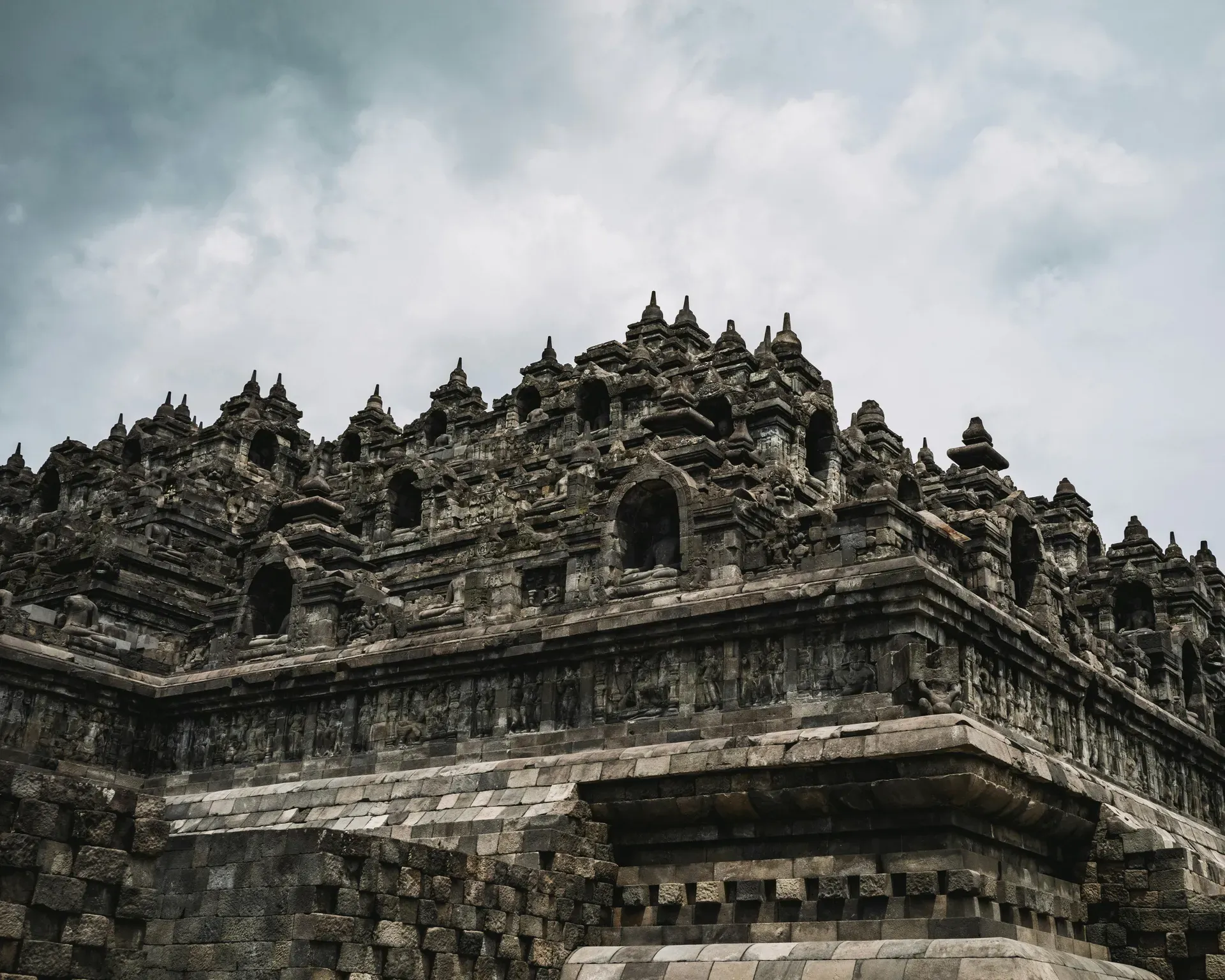
Borobudur stands in Central Java as the world's largest Buddhist temple, constructed from two million blocks of volcanic stone. The 9th-century Mahayana monument functions as a massive step pyramid guiding pilgrims through physical representations of Buddhist cosmology.
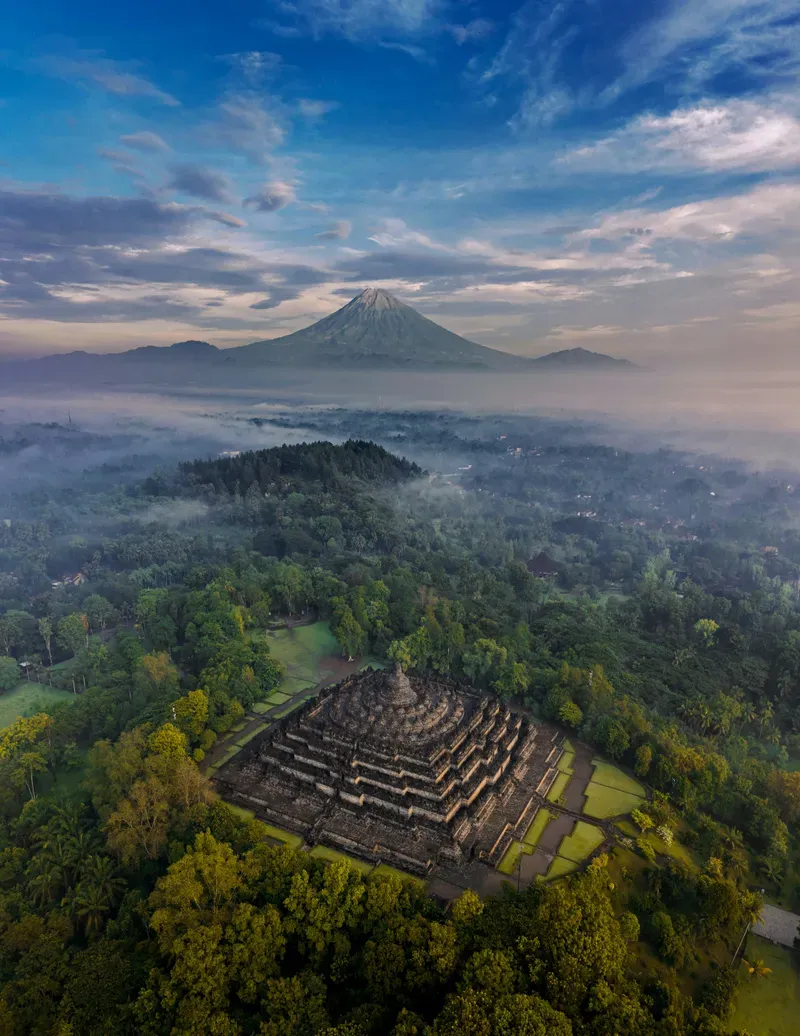
Two million blocks of volcanic stone form the world's largest Buddhist temple. Borobudur rises 35 meters above the Kedu Valley in Central Java, 40 kilometers northwest of Yogyakarta. Twin volcanoes—Merapi-Merbabu and Sundoro-Sumbing—flank the monument, while the Progo and Sileng rivers flow nearby. The structure consists of nine stacked platforms. Six square levels form the base. Three circular terraces sit on top, crowned by a massive central dome.
Visitors climb steep, narrow stairs to ascend the monument. The journey physicalizes Buddhist cosmology. Pilgrims start at the base, representing the world of desire, and move upward toward the realm of formlessness at the summit. Heat radiates from the dark basalt by mid-morning. There is zero shade on the upper terraces. Humidity often obscures the surrounding jungle and volcanoes, especially during the rainy season from November to March.
Heavy downpours turn the ancient stone steps into slick hazards. Access to the upper structure requires advance booking, as management caps daily climbers at 1,200 people to prevent structural degradation. Foreigners pay 455,000 IDR for a structure ticket, which includes a mandatory local guide. You must wear provided 'Upanat' woven sandals to protect the stone surfaces. The grounds open at 06:30, but the climb-up structure opens at 08:30. Exiting the complex forces visitors through a one-kilometer maze of souvenir stalls before reaching the parking lot.
Construction began around 780 AD under the Sailendra Dynasty. Workers hauled 55,000 cubic meters of andesite stone from neighboring rivers to build the massive step pyramid. The project consumed 75 to 80 years. Artisans carved 2,672 intricate relief panels into the galleries, detailing Buddhist texts like the Jataka and Lalitavistara. The sheer scale of the labor required thousands of stonecutters, carvers, and laborers working over three generations to assemble the 123-meter-wide base.
The site fell silent in the 14th century. Hindu-Buddhist kingdoms in Java declined as Islam spread across the archipelago. Volcanic ash from nearby Mount Merapi buried the lower levels. Thick jungle canopy eventually swallowed the entire structure. Locals avoided the hill, associating the overgrown ruins with bad luck and ancient spirits. The monument remained hidden from the outside world for nearly five hundred years, existing only in Javanese folklore as a cursed hill.
Sir Thomas Stamford Raffles, the British ruler of Java, heard rumors of a massive monument hidden deep in the jungle in 1814. He dispatched Dutch engineer H.C. Cornelius to investigate. Cornelius and 200 men spent two months hacking away vegetation and digging through volcanic ash to reveal the stone carvings. The unearthing exposed the temple to the elements and looters. Thieves decapitated hundreds of Buddha statues, selling the heads to private collectors and foreign museums. The King of Siam carted away eight cartloads of statues and panels during an 1896 visit.
The Indonesian government and UNESCO launched a massive intervention between 1973 and 1983. Engineers dismantled the five square terraces block by block. They installed concrete foundations and PVC drainage pipes to stop water seepage from destroying the hill's core. Workers cleaned and treated over a million stones before reassembling the puzzle. Borobudur received official UNESCO World Heritage status in 1991. Today, the monument faces new threats from mass tourism. Foot traffic eroded the original stone steps by several centimeters, prompting the 2020 ban on direct sunrise access and the introduction of strict daily climber quotas.
Borobudur contains 55,000 cubic meters of interlocking volcanic stone. Builders used no mortar. They cut joints into the andesite blocks, fitting them together like a massive three-dimensional puzzle. The base measures exactly 123 by 123 meters. From the ground to the tip of the central dome, the monument stands 35 meters high. The entire structure wraps around a natural dirt hill, relying on gravity and precise stone-cutting to stay upright.
The architecture dictates a specific walking path. Visitors enter from the east and circulate clockwise, keeping the monument on their right. This practice guides walkers past 2,672 narrative and decorative relief panels. These carvings stretch for a total length of 2.5 kilometers. Stone lions guard the steep staircases on all four sides. Gargoyle-like waterspouts, carved as giant makaras, jut from the corners to channel heavy tropical rain off the galleries. The lowest level contains 160 hidden panels depicting worldly desires, which builders deliberately encased behind a massive stone wall to stabilize the structure.
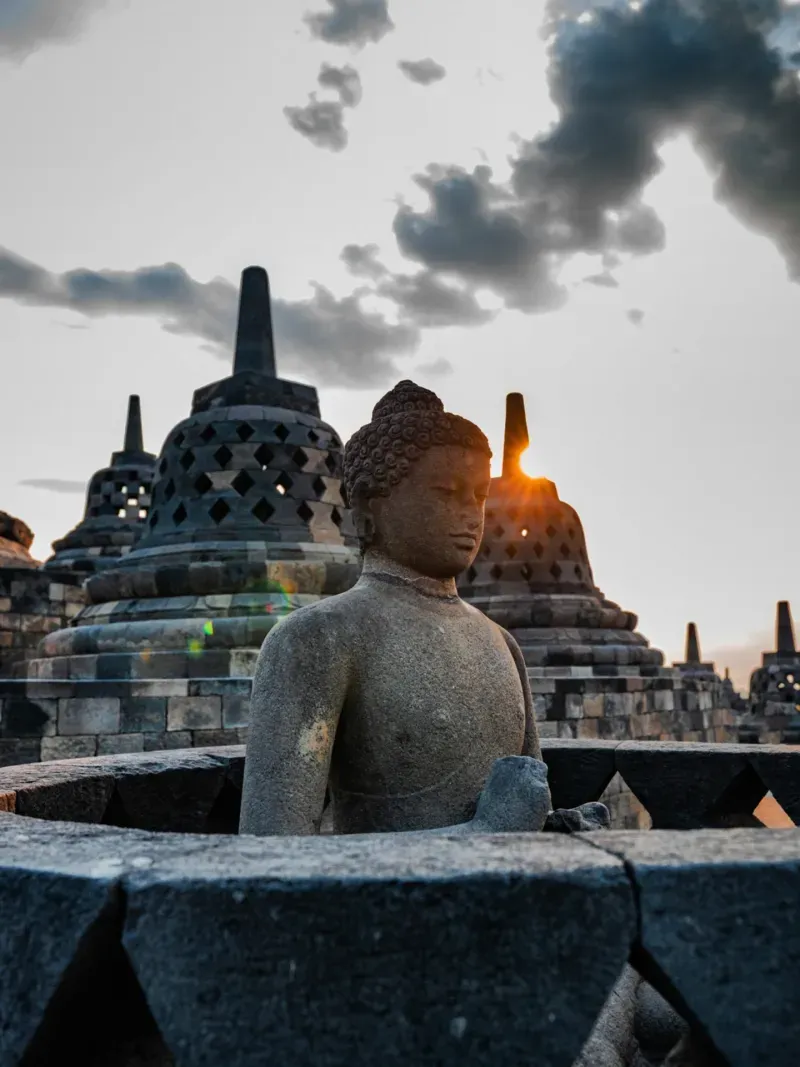
Seventy-two perforated stupas ring the three upper circular platforms. Each bell-shaped structure houses a seated Buddha statue. The diamond and square-shaped holes in the stone lattice allow visitors to see the figures inside. At the exact center sits the main dome, measuring 9.9 meters in diameter. Unlike the smaller stupas, this central dome is completely solid and empty. The temple originally featured 504 Buddha statues, though many are now headless. Touching the remaining statues through the lattice is strictly forbidden and triggers immediate removal from the site.
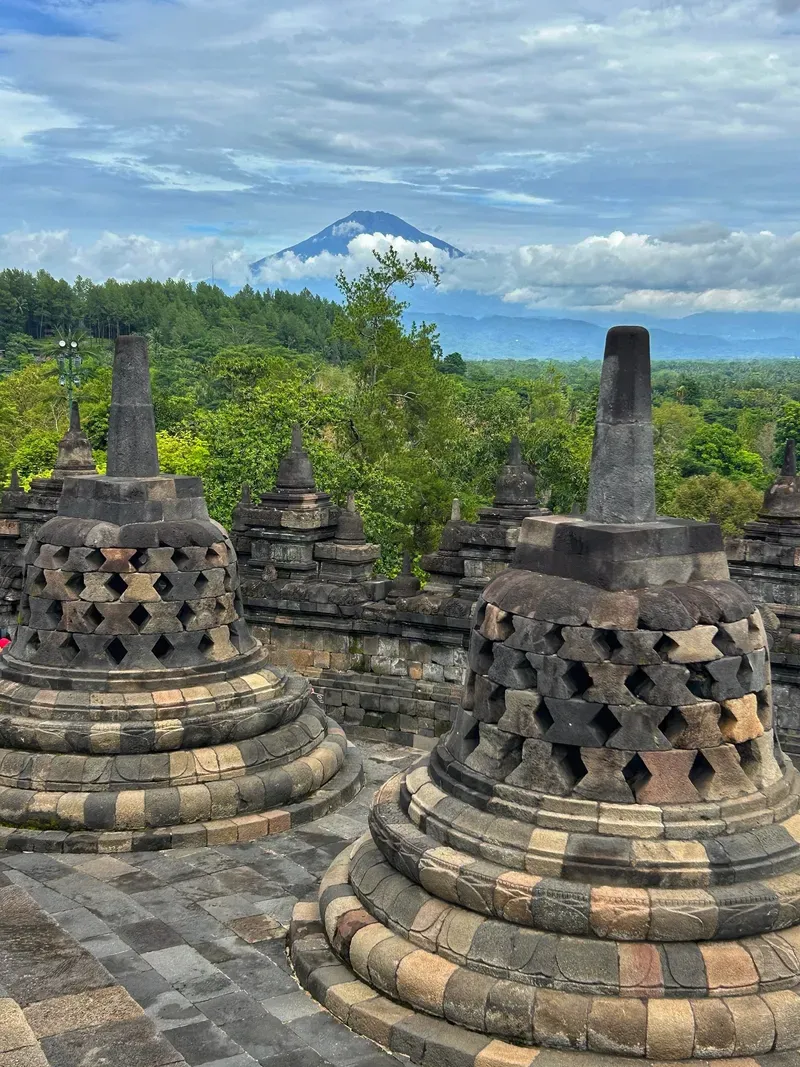
Borobudur functions as a three-dimensional mandala. The architecture maps the Buddhist path to enlightenment. The hidden base represents Kamadhatu, the realm of human desires and earthly consequences. The five square terraces form Rupadhatu, the realm of form, where humans abandon their desires but remain bound to name and shape. The top circular platforms embody Arupadhatu, the realm of formlessness, represented by the stark, unadorned stupas against the open sky. The Buddha statues on the square terraces display different hand gestures (mudras) depending on which compass direction they face, symbolizing specific teachings.
Thousands of monks converge on the monument every May or June for Vesak (Waisak). This full-moon festival commemorates the birth, enlightenment, and death of Gautama Buddha. Pilgrims walk an eight-kilometer procession from Candi Mendut, passing through Candi Pawon, before arriving at Borobudur. They chant sutras and release paper lanterns into the night sky. The event draws practitioners from Thailand, Tibet, and Sri Lanka.
Local Javanese culture maintains a complex relationship with the site. Villagers from the surrounding Kedu Valley handcraft the 'Upanat' sandals required for all climbers. This initiative provides direct economic benefit to the community while preserving the monument's physical integrity. The temple also anchors a straight geographical line with Pawon and Mendut temples, a precise alignment that continues to puzzle modern surveyors.
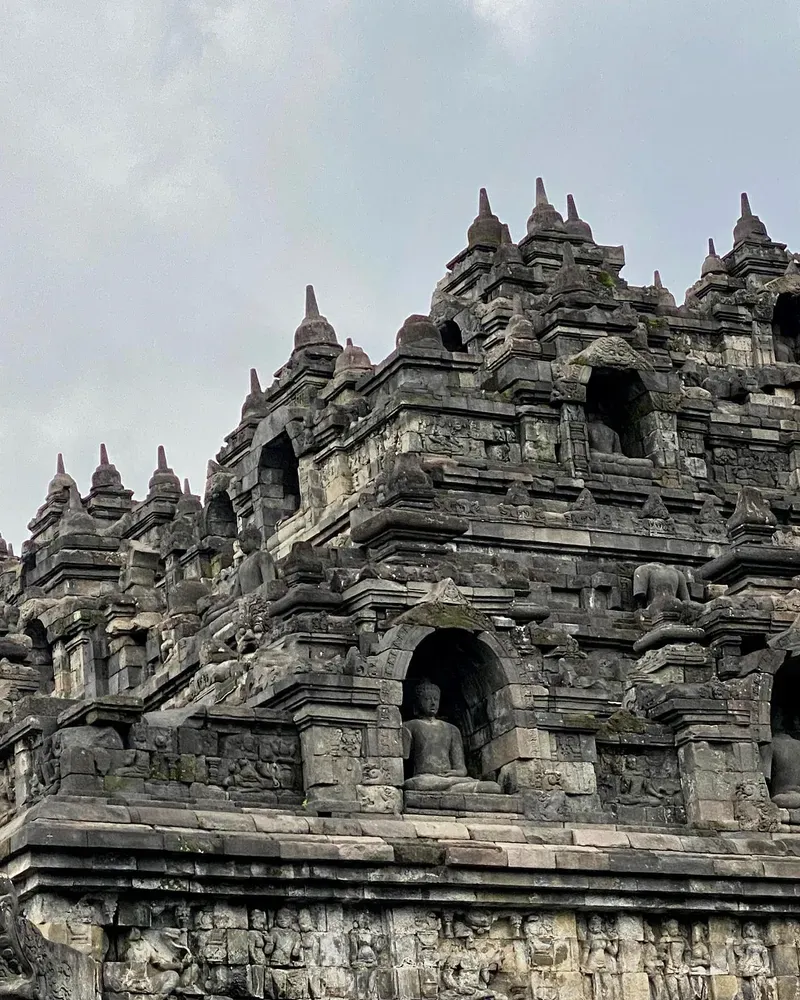
Builders used no mortar, instead cutting joints into 2 million volcanic blocks to fit them together.
Climbers must wear special 'Upanat' woven sandals to prevent further erosion of the ancient stone steps.
Borobudur sits on a straight geographical line with two smaller temples, Pawon and Mendut.
The original foundation contains 160 relief panels depicting worldly desires, which were deliberately covered by a massive stone encasement.
One hundred gargoyle-shaped waterspouts called makaras channel monsoon rains off the stone galleries.
Looters and colonial collectors decapitated hundreds of the site's 504 original Buddha statues during the 19th century.
Mount Merapi erupted and buried the entire structure under thick ash for several centuries.
Borobudur is a 9th-century Mahayana Buddhist temple located in Central Java, Indonesia. It is the largest Buddhist monument in the world, built as a step pyramid with nine stacked platforms.
Construction began around 780 AD during the Sailendra Dynasty. The massive building project took approximately 75 to 80 years to complete.
The site fell out of use in the 14th century as Hindu-Buddhist kingdoms declined and Islam spread through Java. Volcanic ash from Mount Merapi and dense jungle eventually buried the structure.
Yes, but access is strictly limited. Management caps daily climbers at 1,200 people, and you must book a specific 'Temple Structure' ticket in advance.
Direct sunrise access on the monument ended in 2020. Visitors now watch the sunrise from nearby Setumbu Hill before entering the temple grounds at 06:30 AM.
The 2,672 relief panels depict Buddhist cosmology and texts. They tell the story of Gautama Buddha's life and past incarnations through intricate stone narratives.
A guide is mandatory if you purchase the ticket to climb the temple structure. The guide is included in the ticket price and leads a 1.5-hour session.
Visitors must wear modest attire covering their shoulders and knees. The staff provides a free batik sarong at the entrance if your clothing does not meet the requirements.
The temple originally housed 504 Buddha statues. Many are now headless or missing due to centuries of looting and colonial-era artifact collection.
The site is partially accessible. Wheelchair users can navigate the ground-level park and base via ramps, but the steep stone stairs make the upper platforms inaccessible.
Browse verified tours with free cancellation and instant confirmation.
Find Tours